Many manuscripts are submitted to CEP for publication consideration. I like to read the Bible studies, but I don’t start with the written sections, rather, I start with examining the questions. I am convinced if the questions are not written well; the rest is just commentary and not Bible study.
Every question contains an “action verb.” This word determines the level of the question. Remember, the goal of Christian education is not just knowledge, it is changed lives, and this can only be accomplished when we put right knowledge into practice.
 Years ago it was established there are six basic levels by which actions verbs are measured:
Cognitive – This is the lowest level, asking students to recite information given to them.
Comprehension – This level helps the student move from memorization to understanding, such as discovering relationships among facts.
Application – Here the student takes what was learned and puts it into a new setting involving real life.
Analyze – This step requires the taking apart and examining each to see how it relates to the whole.
Synthesize – Now the student is able to take the parts analyzed and put it together into a different setting. This is higher critical thinking. Putting students into a role-play will move them to think through issues they may not have personally encountered, such as taking what they know about their Christian faith and witnessing to a Muslim.
Evaluation – This is the highest level of creative thinking. Now the student will be asked to judge between the good or bad, right or wrong, useful or useless, etc. Competent evaluation requires good analysis.
The cognitive level might be the lowest level, but it is still an important level. Memorizing the books of the Bible may seem mundane, but it is important in enabling students to move to the next level of study.
Read entire issue of Equip to Disciple, 4th Quarter 2011 (Acrobat Reader required).
A colleague of mine in Kenya once told me if he could just get the faculty to teach to the application level he could die a happy man. But, if our goal is to see the lives of those entrusted to us changed, then we must understand the process by which this is done. Memorizing the books of the Bible will not get anyone growing spiritually. They need to be taught to dig into the Bible at a higher level. Memorizing verses will not get them growing spiritually either. (I must add here this is sadly a lost art in the church today, and needs to be rectified.) Learners must understand those verses and be able to apply them. Then they can be taught to think critically about those verses so they will be skilled in growing on their own and be able to teach others also.
When you ask questions in class, or when you write them in a study, you need to evaluate (highest level) your questions. This, again, is determined by the action verbs you use. We will post this article on our website along with a chart giving you the action verbs for each category. Remember, there are times for low level questions, but these should be minimal. Higher critical thinking produces Kingdom minded Christians who know how to think and evaluate their lives and the world around them.
Using higher critical thinking questions works for all learning styles. However, the analytics will be content to stay with the learning of facts. This is never satisfactory, as God requires us to put His Word into practice.
If you are thinking about submitting a manuscript to us, I suggest evaluating your questions first.
 …One thing that was very important to that first Assembly (OPC) was the preaching and teaching of the Word of God. And to do it, the assembly immediately set up three committees to help the congregations as then existed and those that would be formed. Those committees were the Committees on Home and Foreign Missions and Christian Education. The Committees on Home and Foreign Missions had one message. They were obeying Jesus Christ, who said specifically what we were to do. He said in Acts 1, “Ye shall be my witnesses unto me both in Jerusalem, and in all Judaea, and in Samaria, and to the ends of the earth.” In Matthew 28, he said, “All authority is given unto me in heaven and in earth. Go ye therefore, and teach.” That was not just a missionary goal. That teaching included the Bible, the entire content of the Word of God. We came to think of that then, and to call it the Reformed Faith, after the Reformation.
 …I say to you that the work of the Committee on Christian Education is the basic agency of the General Assembly. It is not more important than missions, not at all. How could you beat the importance of those words of Jesus, “Go and teach”? Those are not just important; those are essential, and we must not give them up. But what I am saying is that the Committee on Christian Education has helped our churches to teach those people who go out as missionaries and teach the Word.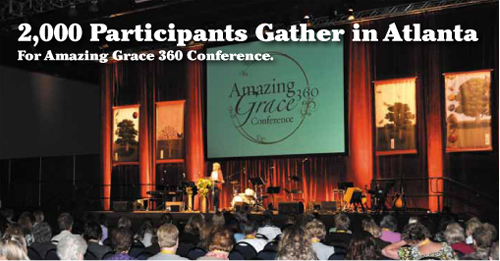
 With the confusion abroad about “grace” the conference sought to present a program that would encourage and enable the participants to understand the “it is all about God” who is a God of grace and mercy. That theme was carried throughout the conference with Nancy Guthrie leading the plenary sessions unfolding the whole story of: creation, fall, redemption, and consummation (covered by Brian Habig mentioned below). Her messages were clear and set the stage for the more than 30 seminars on different aspects of the whole story.
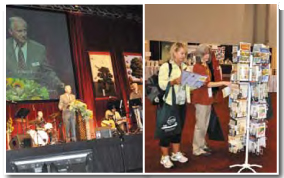 Another of the highlights of the conference was giving the participants an opportunity to see the more than 50 exhibits, featuring a variety of “Christian” ministries in the church, and other church related ministries. They also had an opportunity to see and purchase the many training resources and study materials that were available from CEP. One of the participants remarked, “I have never seen so many good resources relating to women’s ministry in one place.”
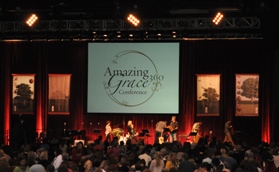 2,000 participants came together at the Cobb Galleria, Atlanta, Ga., Friday, Saturday and Sunday, in Atlanta, for the PCA’s 5th Christian Education and Publications Women’s ministry conference, Amazing Grace 360 emphasizing the whole Gospel for the whole life and whole world. Older women and younger women came from across the PCA with representatives from several countries where PCA ministry is realized. 200 of the participants were under 20 years of age and 200 were over 66 years of age.
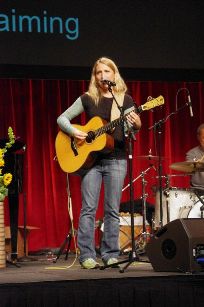 Joni Erickson Tada addressed the conference via video and brought encouraging words to those who have known suffering and the Lord’s faithfulness in sustaining them through difficult times. Nancy Guthrie who had experienced the pain of losing two children was able to meet with many of the mothers present with similar experiences. A fitting climax of the Saturday evening event was remembering Georgia Settle, now with the Lord, who served as the first coordinator of women’s ministry with CEP and the PCA. Her husband Paul, a former coordinator of CEP, was welcomed. He brought a brief message and prayer for the conference.