 Help Teens Discover their Master Plan for Life!
Do your teens groan when you say, “Turn to Genesis 1-3”?
Do they think they know everything there is to know about the biblical account of Creation and the Fall? Do they feel like they’ve heard the story of Adam and Eve a million times?
Your teens may think they know the stories from Genesis 1-3 very well, but the reality is that (for many), their understanding is limited and their knowledge is sprinkled with misconceptions, such as, Didn’t Eve eat an apple?
Genesis 1-3 is a compelling narrative with familiar names but it also deals with hard, profound questions about life-questions that need God’s answers. Foundational answers to basic questions such as Who am I? and What is my purpose? find their starting point in these chapters. They establish a solid footwork to deepen your teens’ understanding of God, the world, redemption, and themselves.
High school students are beginning to think of careers and marriage. They are wondering about themselves and how they fit into the world. They are also living in a very real present-struggling with school, family interactions, relationships with other teens, just to name a few.
In today’s culture, marriage is mocked, work endured, and the Sabbath not even considered. The individual is frequently presented as the center of the universe. And sin? If the word is even used, it refers only to relationships with others, not to a response to God, i.e., As long as you don’t hurt another person, you are not sinning.
So how will your teens find answers to such questions as:
- What should I do with my life?
- What makes life meaningful?
- Is marriage all that important?
- Waiting for sex until marriage-is that realistic?
- What happens in the afterlife?
Challenge teens to explore these questions and learn truth when they use the newest So What? youth Bible study, Identity & Purpose.
During this time of transition from childhood to adulthood, teens are wrestling with making their faith more fully their own. We shouldn’t be intimidated by their doubts and questions; instead, use them as opportunities to look into God’s Word for answers and provide a framework for understanding who they are and how they relate to God, others, and creation.
The church should be a safe atmosphere for your students to struggle with these issues as they look at the Bible to see how it speaks to their world. Encourage them to express their thoughts and questions honestly. Depend on the Holy Spirit to deepen their understanding and grow their faith in Christ as they dig into God’s Word.
Try one free Identity & Purpose lesson at www.sowhatstudies.org
 In our Christian education and Publications training events, we use the phrase “the whole Gospel for the whole church.” We have been asked what we mean by that, to which we have responded: Kingdom discipleship focuses on the whole truth of scripture, and its audience is the entire church at all age levels.
 A kingdom disciple is not only one who knows King Jesus, but one who loves, serves, and thinks like King Jesus. How do we begin to take our children from the classical grammar stage of their faith into the logical and rhetorical living out of what they believe? A standard component of our ministry to children must be parental training. It is the serving, giving, loving, obedient parent who will most likely produce a serving, giving, loving, obedient child. Again, this is a heart issue, but no person can see a parent’s heart better than their own child. They are blessings in this way – always reminding us of our need of saving grace. As we know and see the needs of each individual child, the church’s ministry is to ask what we can do to aid the parent in bringing the child to Christ. This is the gospel message – Jesus came down to earth, becoming man, and we must meet every child and family where they are, while knowing that our God is faithful. He is most glorified when the most difficult circumstances are overcome each day by the work of his grace. True kingdom ministry is never trying to get around a special need, but looking for the power of God to work mightily in it.
 Most churches will at some point wrestle with the question of purpose for their ministry to the next generation. The answer to this foundational question becomes the destination point that the entirety of the youth program is moving toward. In the same way that a GPs needs the destination point in order to tell you how to get there, a youth ministry needs a desired outcome to be able to chart the best course of action. Without a well-thought out, biblically-informed, easily-understood purpose, your youth ministry will waste valuable time on programs that do little more than entertain the rising generation. For this reason, every church should not only do the work necessary to answer the question of purpose in ministry to youth, but it should regularly use that purpose as the lens with which the youth program is evaluated.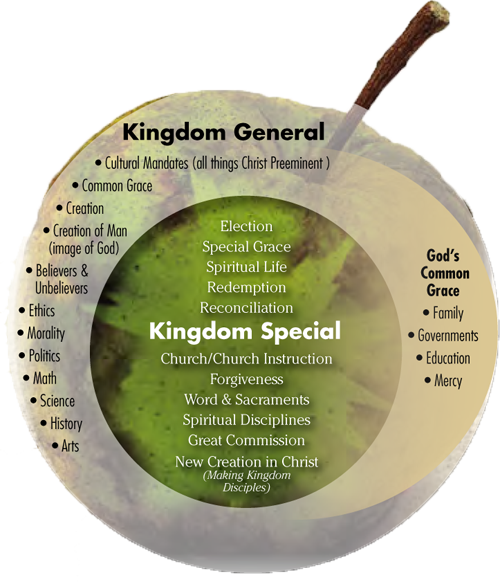

 Kingdom discipleship focuses on the transformation of the mind, not simply in an abstract way, but in a manner that enables Christians to know what God would have them to do in life, as they move outside the special kingdom (the church) into the kingdom general to live with a Christian perspective (see illustration on page 8). The key is to have a kingdom focus that understands and knows what it means to acknowledge King Jesus as Lord of all. Of course, you do not have to be a Christian to live in the kingdom general because it encompasses all of life and reality, but to be a Christian living in the kingdom, you must have a Christian perspective and commitment as you live each day. No matter whether you are a school teacher, a technician, a historian, a scientist, an artist, a politician, etc., God requires that we bring His will and the mind of Christ into all those areas of life. If the church is following His instructions regarding the discipleship of all Christians, young and old, we will be better equipped to live in this world in a way that brings honor and glory to our God and does so in a way that demonstrates a Christian influence in all things. Paul said, “Whether we eat or drink or whatever we do, we are to do all to the glory of God” (I Corinthians 10:31).
 Second, the identification model opens the door to be both in the world and of the world which usually translates that the world has more influence on us than we have on the world. Again, we can and should use much in our culture as a means of serving God and bearing witness to Christ, but not to the point of comprising any part of God’s truth. We live in a fallen world and our culture is not free from the kingdom of darkness influence. Actually, we live in daily spiritual warfare. A further point to remember about this second model is that the more we are like something, especially what we are speaking against, the less influence we will have in that circumstance to make a difference.
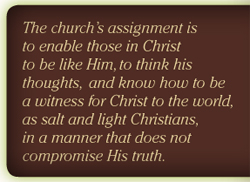
 Developing this world and life kingdom focus means that sermons and Bible studies must be presented in such a way that helps the people to be able to make that kind of world and life view connection. We must know that people in the pew and in our classes struggle to make that connection. They often need help in doing that. So, rather than saying or being tempted to think, “The only way I can survive in this life is to compromise the Christian faith in the marketplace,” we stand strongly and firmly in the Lord and say, “Because of Christ, I cannot compromise His truth even if I am the only one not participating.” That’s where the church’s role to equip Christians to think like a Christian and to live like one, no compromise, but rather to live in a way where all for Jesus comes into play.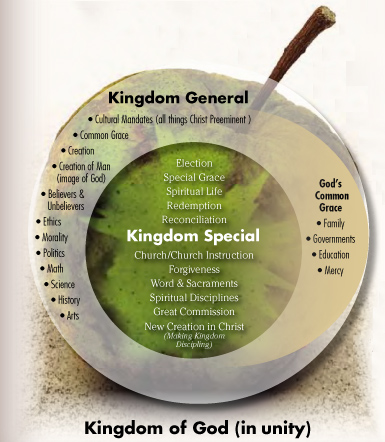
 …One thing that was very important to that first Assembly (OPC) was the preaching and teaching of the Word of God. And to do it, the assembly immediately set up three committees to help the congregations as then existed and those that would be formed. Those committees were the Committees on Home and Foreign Missions and Christian Education. The Committees on Home and Foreign Missions had one message. They were obeying Jesus Christ, who said specifically what we were to do. He said in Acts 1, “Ye shall be my witnesses unto me both in Jerusalem, and in all Judaea, and in Samaria, and to the ends of the earth.” In Matthew 28, he said, “All authority is given unto me in heaven and in earth. Go ye therefore, and teach.” That was not just a missionary goal. That teaching included the Bible, the entire content of the Word of God. We came to think of that then, and to call it the Reformed Faith, after the Reformation.
 …I say to you that the work of the Committee on Christian Education is the basic agency of the General Assembly. It is not more important than missions, not at all. How could you beat the importance of those words of Jesus, “Go and teach”? Those are not just important; those are essential, and we must not give them up. But what I am saying is that the Committee on Christian Education has helped our churches to teach those people who go out as missionaries and teach the Word.